A separate, older tradition of direct cranial-bone manipulation.
Explore Anatomy & Research
Long before CFR or Bilateral Nasal Specific, a different tradition of cranial work developed independently: direct manual manipulation of the cranial bones, without any endonasal or balloon component. Two professions — osteopathy and chiropractic — each credit a different founding figure, and the two traditions emerged within months of each other.
This page covers the direct-manipulation lineage associated with Sutherland, Cottam and Toftness. The endonasal, balloon-assisted lineage that led to CFR — the technique I practice — developed separately. See that history if you haven’t already.
Early, isolated precedents
The earliest documented references to manual cranial manipulation for a therapeutic purpose predate Cottam and Sutherland by decades. An osteopath named Barber published the earliest known pictures and description of manual skull manipulation for headaches and neuralgia in an 1898 book. Willard Carver, D.C. is reported to have used a technique on the head as early as 1906, for hydrocephalus, and made statements in his 1909 book Chiropractic Analysis that appear to refer to cranial manipulation. In 1910, Gregory — a medical doctor associated with chiropractic founder D.D. Palmer — published a photograph of a similar adjustment, captioned as a special adjustment that would often relieve a headache.
None of these early efforts developed into a lasting school of practice the way Cottam’s and Sutherland’s did, and for the next two decades cranial work remained scattered and undocumented among a small number of osteopaths and chiropractors. But they show the idea of manipulating the skull for headache relief was already circulating decades before 1929.
1929: two professions, the same year
The modern history of cranial manipulation is usually traced to 1929, when both Nephi Cottam, D.C. and William Sutherland, D.O. independently presented cranial techniques to their respective professions — Cottam in January, in Salt Lake City, Utah, and Sutherland in September. Neither published right away.
Their approaches differed technically as well as in timing: Cottam’s method used high-velocity, low-amplitude thrusts — the kind of quick, targeted adjustment familiar from chiropractic technique generally — while Sutherland’s used low-velocity, low-amplitude pressures, tractions and torques. That distinction still roughly separates the direct chiropractic and osteopathic cranial traditions today.
William Sutherland, D.O. went on to publish The Cranial Bowl in 1939, describing what became known as cranial osteopathy. His approach centered on the concept of a primary respiratory mechanism — a subtle, rhythmic motion he proposed exists throughout the cranial system — which developed into what osteopathic medicine now calls the craniosacral mechanism. Sutherland is the figure most widely credited with originating cranial manipulation, and within osteopathic medicine that credit is well documented.
Nephi Cottam, D.C. published The Story of Craniopathy: A Science of Health, Its Theory and Practice in 1936, seven years after his 1929 presentation. “Craniopathy” was Cottam’s own term for his approach to the cranium — it belongs specifically to him, not to Sutherland or Toftness — and it was carried forward by his son, Calvin Cottam, D.C., who researched and wrote about his father’s work.
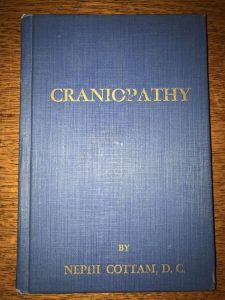
Nephi Cottam’s 1936 book, The Story of Craniopathy, documented his approach to direct cranial-bone manipulation, which he had presented to the chiropractic profession seven years earlier.
A wrinkle in the story: In 2019, I came across a nearly forgotten book by I.N. Toftness, D.C., published in 1932 — four years before Cottam’s book and seven years before Sutherland’s. Toftness practiced in Shell Lake, Wisconsin, and described adjusting cranial displacements as one of the most important advances in chiropractic. In more than 20 years of studying this history, I had never encountered a reference to this book anywhere, including in Calvin Cottam’s otherwise thorough research into his father’s work. Whether Toftness developed his approach independently, or whether the two men were aware of each other’s work, isn’t something the historical record settles.

I.N. Toftness’s 1932 book, Cranial Technique — the earliest full book on cranial adjusting I’ve been able to find, and one that seems to have gone almost entirely unnoticed in the profession’s own historical record.
Robert Fulford and the percussion hammer
Sutherland’s most influential student may have been Robert Fulford, D.O. (1905–1997), who studied cranial osteopathy directly under Sutherland in the mid-1940s and later served as president of the Cranial Academy. Fulford introduced a motorized percussion device into osteopathic treatment — now often called the Fulford percussor — and it became closely associated with his work over a career spanning more than five decades. That same style of instrument, in modified form, is the percussion hammer I use as one of my own tools; see the techniques I use for more.
Why this matters
We’ll probably never know who first had the idea of manipulating the cranial bones for a therapeutic purpose — and it’s entirely possible it wasn’t any of the men usually credited. What the record does show is that direct cranial manipulation and the later endonasal, balloon-assisted techniques developed as genuinely separate traditions, discovered and rediscovered by different practitioners working largely apart from one another. I find that pattern itself telling: multiple independent observers, working decades and disciplines apart, arrived at the idea that the cranium is worth examining and adjusting.
None of that constitutes evidence that any particular technique is effective — independent discovery isn’t the same as validation. But it is a genuinely interesting piece of professional history, and one I think patients curious about this field deserve to know.
References
Berman S. Skull Dysfunction. Cranio: The Journal of Craniomandibular Practice. 1991;9(3):268–279.
Cottam C, Smith EM. The roots of cranial manipulation: Nephi Cottam and “craniopathy.” Chiropractic History. 1981;1(1):31–35.
Sutherland WG. The Cranial Bowl. 1939.
Cottam N. The Story of Craniopathy: A Science of Health, Its Theory and Practice. 1936.
Toftness IN. Cranial Technique. 1932.
Carver W. Chiropractic Analysis. 1909.
Related reading
See the history of the endonasal cranial technique, or read the techniques I use.