How today’s endonasal cranial techniques trace back more than 80 years.
Explore Anatomy & Research
Cranial Facial Release didn’t appear out of nowhere. It belongs to a documented lineage of endonasal, balloon-assisted cranial techniques that stretches back to the years before World War II. Understanding that history doesn’t prove that any particular technique works — but it does help explain where the ideas came from, and why so many different names show up for what are, in many cases, closely related approaches.
This page covers one specific lineage — the endonasal, balloon-assisted techniques that led to CFR. A separate, older lineage of direct cranial-bone manipulation — associated with William Sutherland, D.O., Nephi Cottam, D.C. and I.N. Toftness, D.C. — developed on its own track. See the history of direct cranial manipulation for that story.
Before Bilateral Nasal Specific
The earliest documented intranasal manual techniques predate the names most practitioners use today. Homer Beatty, D.C. described intranasal finger work, including a finger-cot balloon device attached to a sphygmomanometer (blood-pressure) bulb, in his 1939 book Anatomical Adjustive Technic. Thomas Lake, D.C. published his own description of these methods in a 1949 book, Endo-Nasal, Aural and Allied Techniques. In 1947, Joseph Janse, D.C. and colleagues described a pressurized nasal balloon — a lubricated finger cot attached to a blood-pressure cuff bulb, intended to distend the nasal chamber — in Chiropractic Principles and Technic.
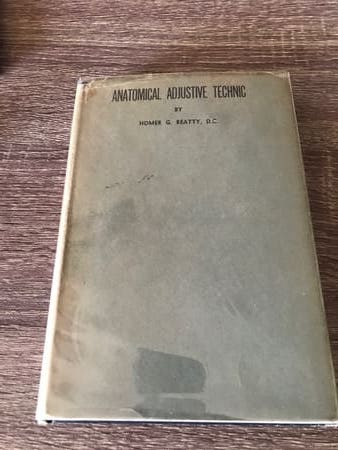
Homer Beatty’s 1939 book, Anatomical Adjustive Technic, contains one of the oldest documented descriptions of an endonasal balloon technique — a finger cot attached to a blood-pressure bulb.
These early descriptions didn’t yet use the term “nasal specific.” That came next.
Frank Finnell and the “Nasal Specific” name
Frank L. Finnell, O.D., D.C. studied directly under Thomas Lake, D.C. and went on to teach eye/ear/nose/throat (EENT) technique at Western States College, where he had also earned his own degree. In 1951, Finnell published Manual of Eye, Ear, Nose and Throat (Portland: Oak Grove Press). I had librarians at University of Western States — the successor institution to Western States College — scan the relevant pages from their copy for me, and they confirm the earliest documented use of the term “Nasal Specific”: Finnell wrote plainly that referring to the treatment as the “nasal specific” would “sound much better” than calling it the “balloon treatment,” which is what practitioners had been calling it up to that point.
Finnell later published a second, related work, Constructive Chiropractic and Endonasal-Aural and Allied Office Technique for the Eye-Ear-Nose and Throat, with a 1st edition in 1950, a 2nd edition in 1954, and a 3rd edition (Ryder Printing) in 1955. I own two copies of that 3rd edition myself.
J. Richard Stober and Bilateral Nasal Specific
J. Richard Stober, D.C. (1922–1988) was one of Finnell’s students at Western States, attending from roughly 1946 to 1951. Stober’s own interest in this area reportedly began earlier, during WWII Navy service in the South Pacific, where he observed an orthopedist treating sailors’ broken noses. While at Western States, he was also exposed to osteopathic cranial manipulation, an interest that historical accounts connect to the work of Wilbur King, D.C. and, more broadly, the cranial concepts of William Sutherland, D.O., the osteopathic physician generally credited as the founder of cranial osteopathy.
According to a 2026 historical account, Stober was already using cranial manipulation with children with disabilities. Around 1955–1956, he began applying Finnell’s nasal-specific technique to those same patients and reported dramatic clinical changes. That combination — cranial manipulation plus the nasal-specific approach — became what he subsequently developed and taught as Bilateral Nasal Specific (BNS).
Historical accounts quote Stober describing patients as living with their “brakes on” because of pressure associated with a tight skull, and BNS as a way of freeing them to function more fully. That language has an obvious echo in how practitioners in this lineage — including how I describe my own work — talk about “freeing the skull.” It’s a historical continuity worth noting, not a scientific claim.
From BNS to NRT, CFR and related techniques
Over the following decades, BNS and its descendants picked up a number of different names as different practitioners adapted and renamed the approach: nasal specific, endonasal technique, endonasal cranial adjustment, balloon-assisted craniofacial adjusting, endonasal facial cranial release, functional cranial release, Nasal Release Technique (NRT), and Cranial Facial Release (CFR) among them.
NRT is a more recent name for this family of techniques, taught through Cynthia Stein, PT, M.Ed. and her Conquer Concussion training program. NRT is marketed specifically toward concussion and post-concussion recovery, and I use it as part of my own approach with athletes who’ve had a concussion. See cranial adjusting and concussion recovery for more on how I think about that population specifically.
CFR specifically is associated with Adam Del Torto, D.C., who is credited with refining the approach from the earlier BNS technique into what is marketed today as CFR. I didn’t invent CFR, and I don’t present it as though I did. It’s the flagship technique in my approach, built on a lineage that goes back through Stober and Finnell to Lake, Beatty and Janse — and I combine it with Afferentology, developed through my own clinical experience.
These related techniques share a family resemblance, but they aren’t identical procedures. Where sources describe specific mechanical differences — in balloon placement, sequence, or the structures targeted — those distinctions matter, and I’ve tried to keep them separate rather than blur them into a single generic story.
The modern historical record
Much of what’s known about this lineage today comes from André Saine, N.D., who learned BNS directly from Stober in 1981 while attending the National College of Naturopathic Medicine, and who is described as one of Stober’s last direct students. Saine is a naturopathic doctor, not a chiropractor, but he became closely involved in this history through his direct study with Stober. He subsequently taught BNS throughout North America and Europe and has since published the most complete historical record available: a 422-page practitioner’s manual in 2025 and a peer-reviewed historical and clinical article in 2026 in the Journal of Clinical Chiropractic Pediatrics. Much of the historical detail on this page is drawn from that record, alongside Finnell’s own books.
What this history does — and doesn’t — establish: A documented lineage tells us where an idea came from and how it evolved. It doesn’t, by itself, establish that the technique is effective for any particular condition. Some of the historical literature in this tradition — and some of the modern marketing around it — includes very broad clinical claims that shouldn’t be carried forward uncritically. One early case report on nasal-specific technique appeared in the peer-reviewed chiropractic literature in 1995, but its authors explicitly called for further research to determine the technique’s independent usefulness and mechanism. That caution still applies today. See what the current evidence shows for a fuller picture.
Where my approach fits in this lineage
CFR is the flagship technique in my practice, but it’s one link in a chain that’s more than 80 years old, developed and modified by a number of practitioners along the way. My own contribution — combining NRT and CFR with Afferentology-based assessment I’ve developed over 22-plus years — is my particular place in that ongoing history, not a claim to have originated the underlying technique.
References
Beatty H. Anatomical Adjustive Technic. 1939.
Lake T. Endo-Nasal, Aural and Allied Techniques: Ear, Eye, Nose and Throat. A Manual of Manipulative Techniques for Conditions of Anoxia and Anoxemia. 1949.
Saine A. Who Can Benefit from the Bilateral Nasal Specific Technique? A Clinical and Historical Perspective. Journal of Clinical Chiropractic Pediatrics. 2026;23(1):2114–2126.
Saine A. The Art, Principles and Practice of Bilateral Nasal Specific: A Practitioner’s Manual. Dare to Know Press / Canadian Academy of Homeopathy, 2025.
Finnell FL. Manual of Eye, Ear, Nose and Throat. Portland, OR: The Oak Grove Press, 1951.
Finnell FL. Constructive Chiropractic and Endonasal-Aural and Allied Office Technique for the Eye-Ear-Nose and Throat. 1st ed. 1950; 2nd ed. 1954; 3rd ed. Portland, OR: Ryder Printing, 1955.
Case report on nasal specific technique. Journal of Manipulative and Physiological Therapeutics. 1995.
Related reading
See the history of direct cranial manipulation, the techniques I use, or read what the current evidence shows.